Last Updated: October 22, 2026
Quick Summary
To track progress multi-book series effectively, use a two-layer system: a series dashboard that records your current book and completion percentage, plus per-book entries that capture where you stopped and unresolved questions. Update your stopping point immediately after closing each book, and reread your spoiler-safe reminder after any long reading gap to maintain continuity.
- A series dashboard answers where you are in the series; per-book entries answer where you are in each book.
- Record your stopping point the moment you close the book, not later, for accurate reference.
- A spoiler-safe continuity note should contain only what the narrator knows at your stopping point, never theories or later revelations.
- Track plot threads by noting when each was introduced and marking their status as resolved, ongoing, or paused.
- Keep each series in its own section when managing multiple series simultaneously to prevent confusing character names and plot details.
Table of Contents
- Why Tracking Progress Matters in Multi-Book Science Fiction Series
- Set Up a Reading Journal to Track Progress in Your Series
- Create a Multi-Book Series Outline Template
- Develop a Series Bible Template for Writers and Readers
- Use a Book Series Continuity Checklist
- Track Plot Threads in a Series Systematically
- Use Digital Tools and Apps for Series Tracking
- Manage Multiple Series at Once
- Frequently Asked Questions
Why Tracking Progress Matters in Multi-Book Science Fiction Series
Reading a multi-book science fiction series is an investment in characters, worlds, and plot threads that span months or years, which is why you need to track progress multi-book series effectively.
Science fiction sagas often introduce dozens of characters, multiple timelines, and interconnected plot threads. Miss one detail in book two, and book three won’t make sense.
Readers often abandon series halfway through, not because they lose interest, but because they lose track. The fix is a structured approach to recording what matters.
Tracking your progress through a multi-book series serves three core purposes:
- Continuity protection. You remember character names, relationships, and backstory without rereading previous books.
- Pattern recognition. You spot foreshadowing and plot threads that pay off across multiple books.
- Reading momentum. You know exactly where you left off and what to expect next, so you jump back in faster.
This matters most for science fiction. The genre thrives on complex worldbuilding and layered narratives.
Set Up a Reading Journal to Track Progress in Your Series
A reading journal to track progress multi-book series is not a diary. It is a working reference you reopen months later to answer three questions fast: Where did I stop? What just happened?
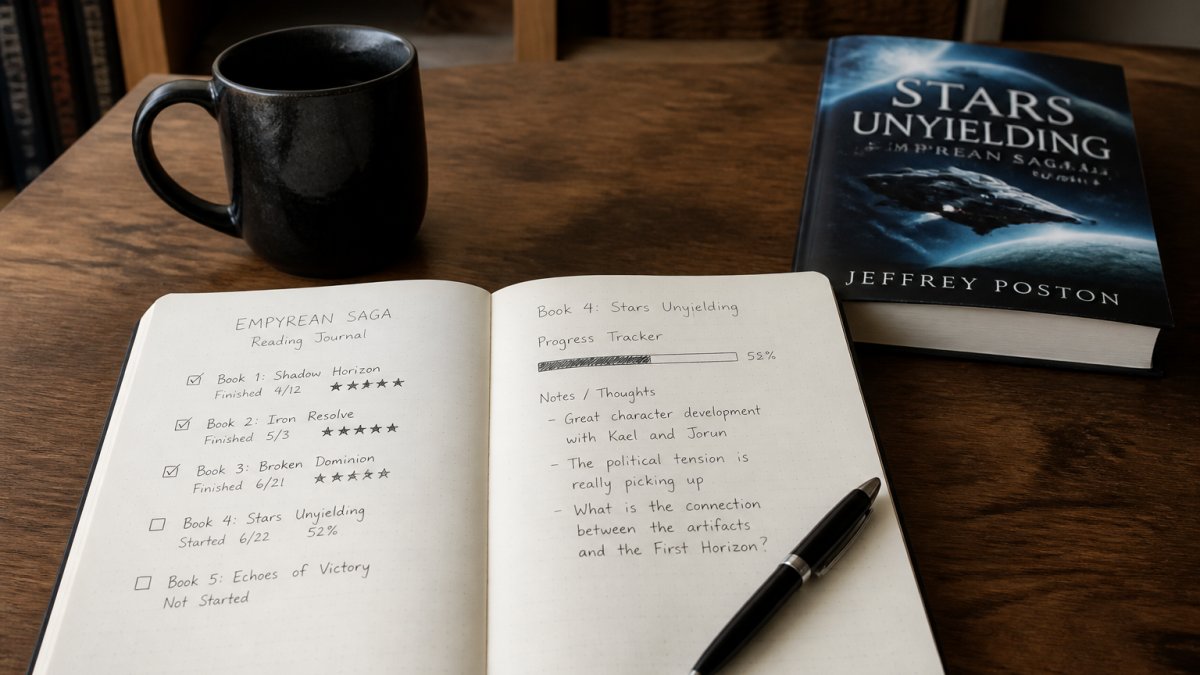
The most reliable pattern is a two-layer system: a one-page series dashboard for the whole saga, plus a short per-book entry you fill in as you read.
Paper vs. Digital: Choose Your Format
Paper journals suit readers who like handwriting and minimal distractions. They are portable, require no login, and writing by hand aids memory retention.
Digital journals offer searchability, backup, links, images, timestamps, and cross-device sync, which matters if you switch between ebook, audiobook, and physical book.
Neither is objectively better. Pick the format you will actually use consistently. A practical compromise: keep the series dashboard digital for searchability and backup, and keep per-book notes on paper or in a notes app you already open daily.
A Reusable Tracker Template
Here is a complete, reusable template. Copy it into a spreadsheet, a notes app, or a notebook. One row per book, one dashboard per series.
Series dashboard (one per series):
| Field | What to record | Example entry |
|---|---|---|
| Series title | Full name and author | Example: The Long Orbit, by [Author] |
| Total books planned | Published plus announced | 7 published, 2 announced |
| Reading order chosen | Publication or chronological | Publication order |
| Current book | Title and number | Book 4 |
| Current position | Page, percent, or timestamp | 62% (ebook) |
| Last read date | Date you last opened it | March 3 |
| Series completion | Books finished ÷ total planned | 3 of 9 (33%) |
| Next release date | Announced or TBA | TBA |
Per-book entry (one per book):
| Field | What to record |
|---|---|
| Title and book number | Reference information |
| Format and edition | Print, ebook, audiobook; narrator if audio |
| Start and finish dates | Track pace and gaps |
| Where I stopped | Page, percent, or chapter |
| Main characters introduced | Names, roles, key traits |
| Plot summary | Three to five sentences, not chapter-by-chapter |
| Unresolved questions | Threads you are waiting on |
| Spoiler-safe reminder | One line you can reread without spoiling later books |
| Series connections | What carries forward from earlier books |
Three to five fields per entry is enough for most readers. The goal is quick reference, not exhaustive documentation. Filling in only the dashboard plus “where I stopped” and “unresolved questions” already avoids most continuity problems.
Update the “where I stopped” field the moment you close the book, not later. A page number or audiobook timestamp you record immediately is worth more than a perfect summary you never write.
Measure Progress and Set Realistic Goals
Four metrics do most of the work:
- Books completed. Count finished books, not pages read. It is the clearest signal of series progress.
- Series completion percentage. Books finished divided by total planned books. Recalculate when a new installment is announced.
- Reading pace. Pages or listening hours per week, averaged over your last two or three books. Use it to estimate when you will finish the series.
Set goals in books per month, not pages per day. One book per month is easy to check and adjust. If a new release is coming, work backward from the release date using your average pace to decide whether to start now or wait.
A reader-focused tracker has two layers: a series dashboard for position and completion, and a per-book entry for where you stopped and what is unresolved. Record your stopping point immediately and review your spoiler-safe reminder after any long gap.
Create a Multi-Book Series Outline Template
A series outline maps your entire reading journey, showing where each book fits and what role it plays in the larger narrative.
List every book in publication order, including release date and your planned reading order (sometimes these differ), and note which are completed and which are upcoming.
Add a one-sentence summary of each book’s central conflict for a bird’s-eye view of how the series progresses.
A simple template looks like this:
| Book | Release Year | Status | Central Conflict |
|---|---|---|---|
| Book One | 2020 | Completed | Protagonist discovers hidden truth about their world |
| Book Two | 2021 | Completed | Protagonist must choose between two impossible options |
| Book Three | 2023 | In Progress | Protagonist confronts the final antagonist |
| Book Four | TBA | Upcoming | Resolution and aftermath |
Refer to this roadmap when you forget which book introduced a character or when the next release is expected.
Develop a Series Bible Template for Writers and Readers
A series bible consolidates everything you need to know about your multi-book series in one place. Readers treat it like a personal wiki; writers use it to maintain consistency across books. The structure works for both.
What to Include in Your Series Bible
Your series bible should contain these sections:
World and Setting. Describe the primary locations, geography, and rules of the world. Include technology level, magic systems, or scientific concepts unique to the series. Note how the world changes across books.
Character Directory. List every major and supporting character with physical descriptions, backgrounds, relationships, and character arcs.
Timeline. Create a chronological sequence of major events. Include both in-world history and real-world publication dates.
Worldbuilding Details. Document currency, government systems, cultural practices, or scientific rules.
Glossary. Define specialized terms, place names, or concepts unique to the series.
Get the Ebook set at a 67% discount →
Update your series bible after each book; it becomes increasingly valuable as the series progresses.
Use a Book Series Continuity Checklist
A continuity checklist prevents plot holes and character inconsistencies. Review it before starting a new book to refresh your memory and prep for what is coming.
The harder problem for readers of long science fiction series is remembering characters, factions, technology, and unresolved threads without accidentally revealing later-book events. That is where a spoiler-safe continuity note does the work.
Continuity Elements to Monitor
Track these elements to catch inconsistencies:
- Character appearance and traits. Hair color, eye color, height, scars, or distinguishing marks should remain consistent unless explicitly changed.
- Character relationships. Romantic partnerships, friendships, and rivalries should evolve logically, not contradict previous books.
- Timeline accuracy. Events should occur in a logical sequence. Watch for impossible timelines (someone aging too quickly or events happening out of order).
Mark off each element as you verify it to catch subtle contradictions that break immersion.
Write Spoiler-Safe Continuity Notes
A spoiler-safe note is a short reminder written so that rereading it cannot reveal anything you have not already read. The rule is simple: write only what the narrator or viewpoint character knows at the point where you stopped. Never write what you suspect will happen, and never write a fact you learned from a later book.
A practical format, one per book, kept to five lines:
- Where I stopped. Chapter, page, percent, or audiobook timestamp.
- Who is on stage. Only characters who have appeared so far, with one trait each.
- What is unresolved. Open questions as of your stopping point, phrased as questions, not answers.
- What changed. The one or two events that moved the story forward.
- What to watch for. A neutral cue, such as “the faction introduced in chapter four,” without saying what it does later.
Do not write down fan theories or spoilers you have seen online. A note that says “the mentor is secretly the antagonist” ruins the reveal the moment you reread it. Keep notes to what the text has confirmed.
Handle Publication Gaps, Reordered Reading, and Unfinished Series
Long science fiction series rarely arrive in a clean sequence. Three situations break most tracking systems, and each has a fix:
- Publication gaps. Record the announced release date for the next book on your dashboard. When a gap stretches past a year, reread your spoiler-safe note for the last book before starting the new one. If no date is announced, mark it TBA and check the author’s or publisher’s official page rather than relying on rumor.
- Publication versus chronological order. Some series include prequels and novellas that sit earlier in the timeline but were published later. Decide your order once, record it on the dashboard, and note on each book entry whether it is publication order or chronological order. Mixing the two mid-series is the most common cause of confusion.
- Novellas and side stories. Treat them as their own rows in your tracker, marked as novella or side story, with a note on where they fall in your chosen order. Skipping them is fine, but record that you skipped them so a later reference does not confuse you.
A continuity checklist catches inconsistencies; a spoiler-safe note protects your reading experience. Write notes only from what the text has confirmed, record your chosen reading order once, and keep paused or unfinished series on a separate list so they do not clutter your active tracker.
Track Plot Threads in a Series Systematically
Plot threads are the narrative strands that weave through a multi-book series. Some resolve quickly; others span every book. Tracking them prevents confusion and builds anticipation.
Identifying and Mapping Plot Threads
A thread is any question, conflict, or mystery that drives the narrative forward. Identify every significant one.
Examples include:
- A protagonist’s quest to uncover their past
- A slow-burn romance that develops across books
- A mystery about the true nature of the world
List each thread and note when it was introduced. Then track its progression through each book. Does it develop? Pause? Reach a climax? This map shows you how the author weaves threads together.
Monitoring Unresolved Story Arcs
Some threads resolve within a single book. Others remain open across multiple books, building tension.
Create a column in your tracking system for “Status: Resolved / Ongoing / Paused.” This helps you distinguish between threads that are actively developing and those that might resurface later.
Pay special attention to threads that go quiet. An unresolved thread from book two might explode in book four. Your tracking system reminds you it exists when the payoff arrives.
Use Digital Tools and Apps for Series Tracking
Digital tools offer advantages that paper journals can’t match. They’re searchable, shareable, and accessible across devices.
Many readers use spreadsheets to track multi-book series.
Other readers prefer dedicated reading apps.
The best tool is the one you’ll use consistently. If a spreadsheet feels like work, choose an app instead.
Digital tools shine when you’re managing multiple series at once. They let you quickly switch between series without losing context.
Manage Multiple Series at Once
Reading multiple science fiction series simultaneously requires organization.
The key is separation. Keep each series in its own section of your tracking system.
Update your tracking immediately after finishing a book. Don’t wait.
Set a reading schedule that alternates between series. Read book one of series A, then book one of series B.
Consider the complexity of each series. If one series is densely plotted and another is straightforward, balance them.
Tracking your progress through a multi-book science fiction series transforms the reading experience. Enjoy significant cost savings on complete series with discounted ebook, audiobook, and paperback sets, making it easier than ever to experience these compelling, adventurous worlds.
Frequently Asked Questions
How do you keep track of a multi-book series?
Create a dedicated tracking system using a reading journal, spreadsheet, or app that records which book you’re reading, your current page or chapter, key plot points, and character details. Write spoiler-safe summaries after each book to refresh your memory before starting the next one. Update your tracker regularly, even weekly notes prevent losing important details across months or years of reading. Most readers find a combination of methods works best: a journal for personal reactions, a checklist for continuity, and a digital tool for managing multiple series simultaneously.
What should a series bible template for writers and readers include?
A series bible should contain a timeline of events across all books, character profiles with physical descriptions and personality traits, a world-building summary covering setting and rules, major plot threads and how they connect across books, and a glossary of terms specific to the series. Include release dates and reading order for each book, major turning points in each installment, and unresolved questions or cliffhangers. For science fiction specifically, document technological systems, political structures, and any complex concepts that recur. This reference guide helps you quickly recall details without rereading entire books.
How do you avoid losing track of unresolved plot threads?
Create a dedicated plot thread tracker that lists every major and minor storyline introduced in each book, marks whether it’s resolved or ongoing, and notes which book it appears in. After finishing each book, review your list and flag threads that remain open. Write brief summaries of where each thread stands, for example, ‘Character X’s origin revealed in Book 2, but motivation for Book 1 actions still unclear.’ Before starting the next book, review these notes to refresh your memory. This prevents confusion and helps you appreciate how the author connects storylines across the series.
What tools can help track a multi-book science fiction series?
Spreadsheets like Google Sheets or Excel work well for organizing book order, reading dates, character arcs, and plot summaries in one place. Specialized apps like Goodreads let you track reading progress and add personal notes. For more detailed tracking, use a bullet journal or Notion database to combine reading progress with character details, world-building notes, and continuity checklists. Some readers prefer simple paper notebooks for a tactile experience. The best tool depends on whether you prefer digital searchability, offline accessibility, or the flexibility to customize your own template. Many readers combine methods, digital for tracking multiple series, paper for personal reactions and detailed notes.
