Last Updated: November 24, 2026
Quick Summary
Writing stories through text messages means telling a narrative almost entirely through chat logs and short message exchanges, with little traditional narration. Use one consistent format, make the sender clear for every message, and let each message move the plot forward.
- Pick one visual style for text messages and keep it consistent throughout the book.
- Always show the sender’s name so readers know who is speaking, even in black-and-white print.
- Add timestamps only when they change the mood, such as a long gap before a reply.
- Give each character a recognizable writing style built from message length, punctuation, or a signature emoji.
- Read each chat scene aloud and cut any message that repeats information the reader already knows.
Table of Contents
- How to Format Text Messages in a Novel
- Text Messages in Books: Examples Worth Studying
- Choosing a Format for Print, Ebooks, and Screen Readers
- Voice, Pacing, and Keeping Chat Scenes Readable
- How to Write Text Messages in Fanfiction
- Common Pitfalls to Avoid
- Start Your First Text-Message Scene This Week
- Frequently Asked Questions
Writing stories through text messages means telling a narrative almost entirely through chat logs, texts, and short message exchanges. This format can build tension fast, because readers see characters talk in real time without long narration getting in the way.
This guide covers how to format texts on the page, how to show who is speaking, how to pace a chat scene, and which mistakes to avoid. If you are weighing narrative formats for your own chat-based story, compare epistolary options beyond text messages.
Text-message fiction is a story told through the messages characters send each other, with little or no traditional narration. The format feels immediate, and it lets readers piece together the plot from what people say and leave unsaid.
Here is what this guide gives you:
- A clear method for formatting texts so readers never get lost
- Ways to show who sent each message and when
- Examples from published books worth studying
- A format decision guide for print, ebooks, and screen readers
How to Format Text Messages in a Novel
Good formatting decides whether readers follow your scene or give up on it. Most chat scenes fail because the reader cannot tell who is talking or when a message was sent.
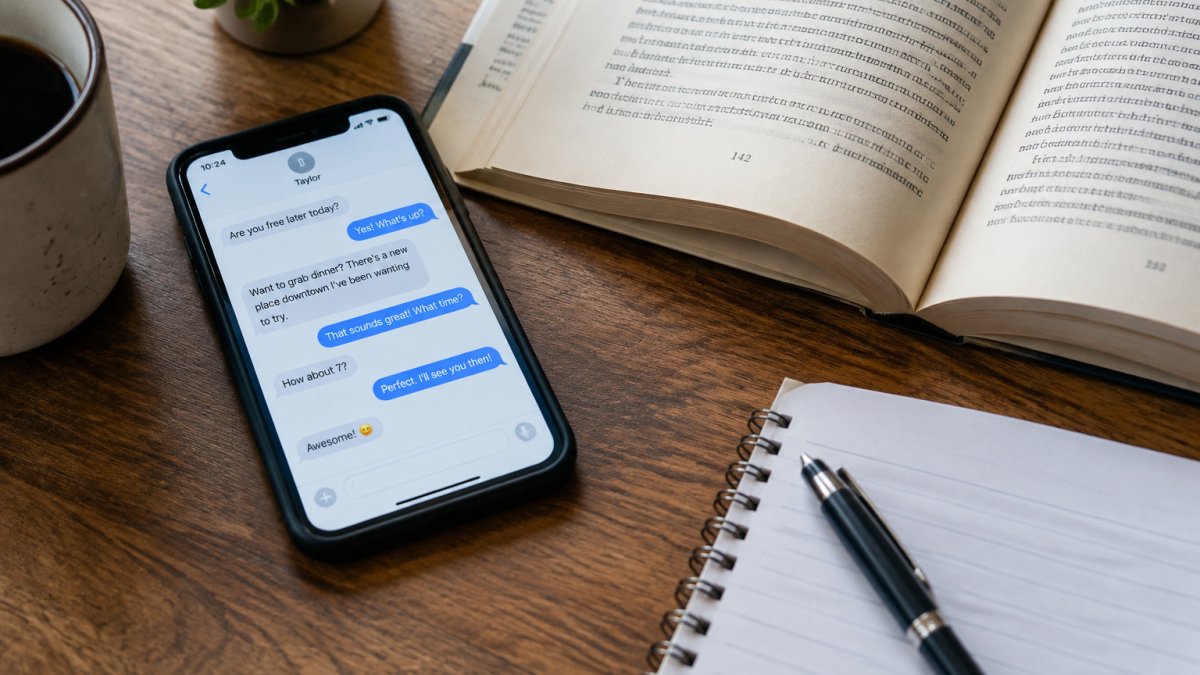
Pick one visual style and keep it for the whole book. Many authors set texts in italics, or use a small label such as the sender’s name followed by a colon.
When you format text messages in a novel, follow a few basic rules:
- Use the same style every time a text appears
- Keep each message short, usually one to three lines
- Separate messages with a line break so each one stands alone
- Avoid mixing texts with spoken dialogue in the same paragraph
Making It Clear Who Sent Each Message
Readers need to know the sender at a glance. Put the name first, or set it in bold, so the eye catches it quickly.
In group chats, this matters even more. Use a consistent name for each character and never switch between a nickname and a full name without a reason.
Watch out: if you rely on color or shading to show the sender, remember that many ebook readers and print copies show only black and white.
Using Timestamps and Message Order
Timestamps tell the reader when a message arrived and how much time passed between replies.
Show timestamps only when they change the meaning. Too many time stamps slow the scene and clutter the page.
Keep message order strict. Readers expect the newest message at the bottom, just as on a phone. Breaking this order confuses people unless you signal the change on purpose.
Text Messages in Books: Examples Worth Studying
Most formatting guides tell you to study published examples and then stop there. This section names specific books and shows you exactly what to look at in each one, so you can turn reading into a usable pattern instead of a vague instruction.
Annotated examples across genres
Texting inside a traditional narrative. Eleanor & Park by Rainbow Rowell and Attachments by Rainbow Rowell both use digital messages as a thread inside a larger story.
Thriller and mystery pacing. In thrillers, a text scene often exists to deliver one piece of information under pressure.
Romance and literary fiction. Romance writers use text exchanges to show chemistry through timing and word choice rather than description.
What to mark in each example
When you read a published chat scene, take notes on four things:
- Sender signal: Is the name a label, a bold lead-in, or part of the message itself?
- Format boundary: How does the author show the scene has left the phone and returned to narration?
- Message density: How many messages appear before a line of narration or a scene break?
- Placement of the key line: Is the most important message first, last, or buried in the middle for effect?
Turn the pattern into your own scene
Copying a layout for practice is fine. The goal is to internalize the structure, then apply it to your own content. Pick one example, rewrite a scene of your own using its sender-signal pattern, and read both side by side.
Watch out: a format that works in a print novel can fail in an ebook, so check any example you imitate against a reflowable screen before you commit to it.
Choosing a Format for Print, Ebooks, and Screen Readers
A text-message scene that looks clean on paper can break on a small phone screen. Plan for every format your readers will use.
Print books give you the most control over spacing, italics, and alignment. Ebooks reflow text to fit each device, so heavy spacing or fixed-width layouts can shift.
Use this quick guide to choose your approach:
| Format | Best Approach | Watch For |
|---|---|---|
| Italics or labels with clear spacing | Page breaks splitting a chat | |
| Ebook | Simple labels, minimal layout tricks | Line breaks changing on small screens |
| Screen reader | Written sender names in every message | Reliance on color or indentation alone |
Keep the sender name in the text itself so screen readers announce who is speaking. Avoid decorative tricks that only work visually.
Voice, Pacing, and Keeping Chat Scenes Readable
Each character needs a distinct voice, and pacing comes from message length and gaps. But the hardest part of a chat scene is balancing realism against readability. Real texts are full of abbreviations, typos, emojis, and autocorrect failures. Put all of that on the page and the scene becomes unreadable. Strip it all out and the characters sound like they are writing formal letters.
Give each character a recognizable writing style
One character might write in short fragments and skip punctuation. Another might send long, careful messages with full sentences and correct grammar. A third might overuse a single emoji or a specific abbreviation. Readers should recognize who is texting before they check the name.
Build the voice from a small set of habits rather than a pile of quirks:
- Message length: short bursts versus paragraph-length replies
- Punctuation: periods for emphasis, no periods at all, or ellipses everywhere
- Capitalization: all lowercase, standard case, or occasional all caps for shouting
- Signature words or emojis: one repeated phrase or symbol per character
Decide how much realism to keep
Use this as a working rule: keep the imperfections that reveal character, cut the ones that only slow the reader down.
- Abbreviations: keep a few that fit the character and the era, such as “lol” or “omw,” but do not stack them so densely that the reader has to decode each line.
- Typos: an occasional typo can show haste or panic, but a page of misspellings reads as an editing error. If a typo matters to the plot, make it deliberate and let another character react to it.
- Emojis: one or two per character can act as a signature. A wall of emojis is hard to read and often impossible for screen readers to interpret.
- Autocorrect failures: a wrong-word substitution can be funny or revealing, but use it sparingly and make sure the intended meaning is still clear from context.
A common pattern is to write the scene at full realism first, then edit it down until every message is readable on one pass. For more proven approaches, explore epistolary techniques that work in message-based scenes. Most practitioners find that the second pass removes about half of the informal markers and the scene gets stronger.
Pace with message length and gaps
Short, rapid messages create urgency. A long pause followed by a single word creates suspense. Mix both to keep the scene moving. A useful technique is to let the gap do the emotional work: three hours of silence before a reply can say more than a paragraph of narration.
Keep the scene readable
- Break up long exchanges with a line of narration when the setting or emotion needs context
- End a scene on a message that raises a question
- Cut any message that repeats information the reader already knows
- Read the scene aloud to catch where the rhythm drags
Watch out: if you rely on emojis or stylized punctuation to carry tone, readers using screen readers may lose the meaning entirely, so pair any visual cue with a plain-language signal in the text.
How to Write Text Messages in Fanfiction
Fanfiction writers often use text-message scenes to show characters interacting in new settings. The same formatting rules apply, but you must also respect the original characters’ voices.
Keep the names, speech habits, and relationships consistent with the source material.
If you adapt a real person’s messages, get permission first and remove identifying details. Privacy and consent matter for any real message content you borrow.
Common Pitfalls to Avoid
- Overusing timestamps: they slow the scene when every line carries one
- Mixing formats: switching between italics, labels, and quotation marks in one scene confuses readers
- Forgetting the sender: a message without a name leaves readers guessing
- Writing only texts: a page of messages with no context can feel empty, so add a line of narration when the setting or emotion needs it
Read each chat scene out loud and check that every message is clear. Edit for both realism and readability.
Start Your First Text-Message Scene This Week
Pick a short scene with two characters and a single goal, such as one person trying to get the other to meet them. If you are new to the craft, a closely related guide on writing fiction through digital chat logs walks through the basics. To give the people texting each other more depth, build character development with suspense-focused advice.
Add timestamps only where they change the mood. Read the scene aloud, then cut anything that does not move the plot forward.
If you want to build the characters behind those messages, Jeffrey Poston Books offers a range of science fiction, political thriller, and historical western series in ebook, audiobook, and paperback formats. Browse the catalog to find a story with the high-stakes pacing you want to study, and see how the author handles voice and tension across a full book.
Frequently Asked Questions
How do you make a story using text messages?
Start with a clear conflict and the characters who are involved in it, then let the messages carry the plot forward. Each message should either reveal something new, shift the tension, or show how a character speaks. Keep the exchanges short and purposeful, and use a consistent format so readers can follow who is talking without effort. Many writers draft the conversation as a plain script first, then add the visual formatting once the sequence of events works.
What is the best way to format text messages in a novel?
Most novels set messages apart from narration with a consistent device, such as the sender’s name in bold or small caps followed by the message in quotation marks or italics. Choose one method and apply it throughout the book. Include timestamps only when timing matters to the plot. Readers should be able to tell at a glance who sent each message and whether a line is spoken aloud or typed on a screen.
Can a whole book be written as text messages?
Yes. Some novels are told entirely through messages, emails, and chat logs, and readers accept this form when the structure is clear. The risk is monotony and confusion over who is speaking. Vary the length of messages, add occasional narration or documents where needed, and keep the cast small enough that readers can track every sender without flipping back.
How can I turn text messages into a book?
Begin by choosing the story you want to tell and deciding which conversations drive it. Remove filler such as greetings and small talk that do not advance the plot. Rewrite abbreviations and slang so they stay readable for a wide audience. Then apply one consistent formatting system across the manuscript and proofread each scene for sender clarity and message order before publishing.
