Quick Summary
Maintaining the value of collectible book sets comes down to preventing damage, since condition drives value and a single weak volume can lower the whole set. Keep every volume in a consistent condition by controlling light, temperature, and humidity, storing books carefully, and handling them with clean hands. Document the set with an itemized inventory, photos, and an appraisal.
- Record every volume’s title, edition, printing, publisher, and year, and photograph covers, spines, and jackets.
- Aim for roughly 65-70°F and 40-50% relative humidity, held as steady as practical.
- Keep the set out of direct sun and use UV-filtering film or low-UV LED lighting.
- Store jacketed books upright in clear, acid-free archival sleeves, and keep slipcases with their books.
- Get a professional appraisal for the full set and update it every few years.
Table of Contents
- Why Condition Drives the Value of Collectible Book Sets
- Step 1: Inventory and Grade Every Volume in the Set
- Step 2: Control Light, Temperature, and Humidity
- Step 3: Store Rare Books Correctly
- Step 4: Handle, Clean, and Restore Only When Necessary
- Step 5: Document Value, Appraisal, and Insurance
- Booking Your Next Step: Keeping Your Set Ready to Sell or Enjoy
- Frequently Asked Questions
Why Condition Drives the Value of Collectible Book Sets
Last Updated: November 2, 2026
Most owners of a complete set think the value is in the titles. It usually isn’t.
Condition is the main driver of collectible book value. Buyers and appraisers look at the cover, the spine, the pages, and the dust jacket before they look at anything else.
That is why maintaining value is mostly about preventing damage. Repairs rarely restore full value, and aggressive cleaning can make things worse.
Step 1: Inventory and Grade Every Volume in the Set
Start by recording every volume in the set. Write down the title, edition, printing, publisher, and year for each book. Photograph the front and back covers, the spine, and the dust jacket. A simple spreadsheet works well.
This inventory does two jobs. It shows you what you own, and it gives you a baseline. If something changes later, you will know.
Using a Simple Condition Scale
Use one consistent scale for every volume, and give each book one grade for the cover and one for the pages. Note any flaws in plain words, such as “spine ends rubbed” or “small crease, upper corner.”
Be honest with the grade. Owners often rate their books higher than a buyer would. Consistent, honest grading makes your records useful when you sell or insure the set.
Checking Set Completeness
Check that every volume is present and matches the others. Look for mismatched printings, missing slipcases, and missing dust jackets. A set where one book has a jacket and the rest do not will often sell for less than a uniform set.
- Confirm the volume count against the publisher’s listing
- Match the printing and binding across all books
- Note any slipcase, box, or bookmark included
- Record which original components are missing
Step 2: Control Light, Temperature, and Humidity
Environment causes more slow damage than almost anything else. Sunlight fades covers and weakens paper. Heat and humidity swings cause warping, foxing, and mold. For a matched set, the risk is compounded: volumes stored on different shelves or in different rooms can age at different rates, and a set that fades unevenly loses the uniform appearance buyers pay for.
Measurable Targets to Aim For
Preservation guidance for paper-based collections generally points to a similar range. Use these as working targets, not absolutes:
- Temperature: roughly 65-70°F, held as steady as practical. Stability matters more than the exact number.
- Relative humidity: roughly 40-50% RH, again held steady. Below about 30% RH paper becomes brittle; above about 60% RH mold risk rises sharply.
- Short-term swings: avoid daily or seasonal jumps of more than about 10% RH or 10°F in the storage area.
- Light: keep the set out of direct sun entirely. For display lighting, low-UV LED sources and limited exposure hours are the safer choice.
A rare or high-value set may warrant tighter control, and a conservator can advise on a specific target.
Monitoring Instead of Guessing
A cheap digital hygrometer shows you the humidity level so you can see problems early. Place one in the room and, if the set is enclosed, one inside the cabinet or closet. Log readings weekly for the first month to learn the room’s pattern, then monthly. A simple notebook or spreadsheet is enough.
Watch out: a hygrometer placed on an exterior wall or next to a vent will read the wall’s conditions, not the set’s. Put it at shelf height, a few inches from the books.
Light: The Slow Fade Nobody Notices
Ultraviolet light does the most harm, so use UV-filtering window film or sheer curtains if the shelves get strong daylight. Interior lighting should be low and kept off when no one is in the room. Fluorescent tubes are a common culprit; if you use them, fit UV-filtering sleeves or switch to LED.
For a matched set, rotate display volumes if you exhibit them. A single volume left in a lit case for months will fade differently from its siblings, and the mismatch is hard to reverse.
Set-Specific Environmental Traps
-
Slipcases and clamshell boxes can trap moisture. If a slipcase feels damp or the books inside smell musty, air the set in a dry room and re-check the hygrometer before returning it.
-
Shelves against exterior walls run cooler and damper. Keep a gap of a few inches between the shelving and the wall so air can move.
-
Attics, basements, garages, and rooms near heaters, vents, or air conditioners see the biggest swings. Avoid them for any set you care about.
-
Stacked volumes trap heat and humidity between covers. If you must store flat, keep stacks low and check the middle volumes first when conditions change.
-
Keep the room out of direct sun
-
Use a hygrometer at shelf height and log readings
-
Target roughly 65-70°F and 40-50% RH, held steady
-
Avoid spots near radiators, vents, and exterior walls
-
Air out slipcases and boxes if they feel damp
The article gives these working targets for storing paper-based collections:
| Factor | Target | Note |
|---|---|---|
| Temperature | Roughly 65-70°F | Stability matters more than the exact number |
| Relative humidity | Roughly 40-50% RH | Below about 30% paper gets brittle |
| Short-term swings | Under about 10% RH or 10°F | Avoid daily or seasonal jumps |
| Light | No direct sun | Use low-UV LED sources for display |
Step 3: Store Rare Books Correctly
Good storage protects the spine, the boards, and the jacket. Shelve the set with care so no book is pressed or pulled out of shape.
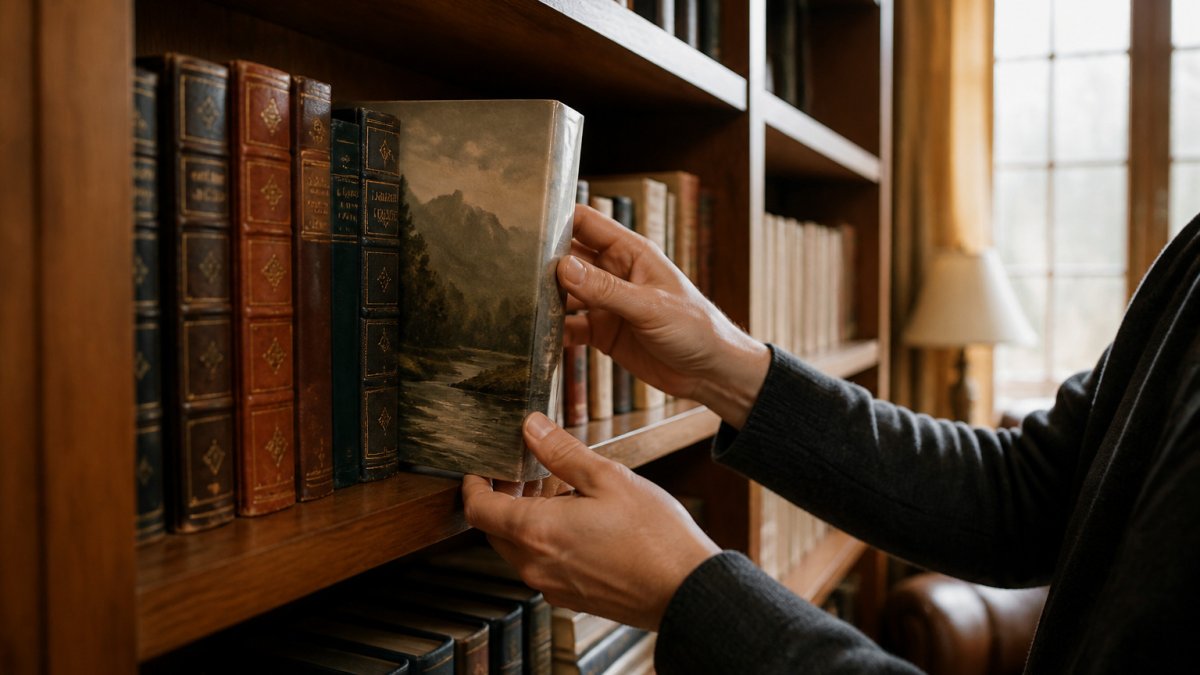
Upright Versus Flat Storage
Shelve most books upright, supported so they stand straight without leaning. Use bookends when a shelf has gaps. A book that leans for years can warp or develop a broken spine.
Lay very large or fragile volumes flat. Flat storage suits oversized books and books with loose boards. Do not stack heavy books on top of lighter, delicate ones. Keep the weight low and even.
Protecting Dust Jackets and Slipcases
The dust jacket often carries much of a book’s collectible value. Store jacketed books upright in a clear, acid-free archival sleeve or a rigid protective cover. Use only archival-quality materials.
Keep slipcases and boxes with their books. If a slipcase is loose, store it flat near the set rather than on a shelf where it can crush.
Handle the book from the spine and boards, never by the jacket flaps. Keep your hands clean and dry, and avoid touching the page edges.
Step 4: Handle, Clean, and Restore Only When Necessary
Handling is a common source of damage. Wash and dry your hands before you touch the books. Work on a clean, flat surface and support the whole book when you lift it.
Clean only what you must. Dust with a soft, dry brush or a clean microfiber cloth, and dust the shelf too.
Restoration is a serious decision. A professional book conservator can assess a damaged volume and advise on what is safe (Hiring a Conservation Professional).
A common mistake is treating a minor problem with a quick fix.
Step 5: Document Value, Appraisal, and Insurance
Documentation supports both value and protection. Keep your inventory, condition notes, photos, and any receipts or provenance records together in one place. Store a digital copy somewhere separate from the books.
What Insurers and Appraisers Typically Ask For
A collectibles policy or rider usually needs more than a list of titles. Insurers and appraisers commonly ask for:
- A per-volume inventory with title, edition, printing, publisher, and year
- Condition grades and notes for each volume, using the same scale throughout
- Photographs of covers, spines, jackets, copyright pages, and any defects
- Proof of ownership, such as receipts, auction records, or estate paperwork
- Provenance notes: prior owners, bookplates, inscriptions, or exhibition history
- A stated replacement value, not just a purchase price
Get a professional appraisal for the full set, especially if you plan to insure it. Insurers usually ask for a documented value, and a current appraisal helps you set an accurate coverage amount. Update the appraisal every few years, since values change with the market.
Watch out: a policy that lists only a total dollar figure without per-volume detail can be hard to settle if one volume is damaged or lost. Push for itemized coverage where the set is valuable.
How Completeness and Consistency Drive Set Value
A complete, uniform set often brings more together than its volumes would separately, but this varies by series and market. The factors buyers and appraisers weigh:
- Completeness: every volume present, with the correct volume count confirmed against the publisher’s listing
- Matching editions and printings: mixed printings within a set usually sell for less than a uniform run
- Condition consistency: one weak volume pulls down the whole set, so a set graded uniformly Very Good often outperforms a set with one Fine volume and several Good ones
- Original components: slipcases, boxes, jackets, and inserts add value when present and matched
- Demand: some series have active collector communities; others do not, and completeness matters less where demand is thin
Selling the Set Whole or in Parts
Before you sell, compare recent sales of similar sets rather than asking prices. Sold records show what buyers actually paid.
Consider whether to sell the set whole or in parts. A complete, uniform set often brings more together than its volumes would separately, but this varies by series and market.
Watch out: a set that has been cleaned, repaired, or rebound without disclosure can lose trust with buyers. Be upfront about any work done, and keep the conservator’s written report with the set’s records.
Booking Your Next Step: Keeping Your Set Ready to Sell or Enjoy
Protecting a collection is an ongoing task, not a one-time job. Re-check your inventory each year, track humidity, and update your photos when anything changes. Small, steady habits keep a set in good condition far better than rescue efforts later.
Whether you plan to keep the set for reading or sell it someday, the same care applies. For questions about your collection, contact Jeffrey Poston Books to talk through your options.
Frequently Asked Questions
What are some collectible books that are worth money?
Value depends more on the specific title, edition, printing, and condition than on the genre alone. First editions in fine condition with original dust jackets generally bring the highest prices, while later printings of popular series are often worth far less. Check recent auction records and completed sales for comparable copies before deciding what your books are worth.
Should old books be stored upright or flat?
Most collectible books should be stored upright on a sturdy shelf, supported by bookends so the spines stay straight and the text block does not sag. Lay books flat only when they are oversized, very fragile, or have a damaged spine that needs support. Avoid stacking heavy volumes on top of each other, since the weight can crease covers and distort bindings over time. Keep books snug but not crammed, so you can remove and replace them without force.
Does keeping a book set complete increase its value?
Yes, in most cases a complete set sells for more than the sum of its individual volumes, because collectors often want the full run and will pay a premium to complete their own sets. Missing volumes, replaced slipcases, or absent dust jackets can significantly reduce value. If you plan to sell, keep the set together and avoid separating volumes, since a broken set is usually worth much less than one that stays intact.
How do you protect collectible books from sunlight and humidity?
Keep books away from direct sunlight and strong indoor lighting, since UV rays fade dust jackets and bindings over time. Aim for a stable room temperature and relative humidity that does not swing widely, because fluctuations cause warping and encourage mold. Use a hygrometer to monitor conditions, and avoid placing shelves against exterior walls where moisture collects. A dehumidifier or climate control in a dedicated room helps protect a valuable collection.
