
Table of Contents
- The Real Math Behind Complete Series Bundles
- Bundle vs. Individual Discs: A Cost Comparison
- Best Complete Science Fiction Book Sets for Shelf Appeal
- Pros and Cons of Book Box Sets
- How to Save Money on Book Series
- Risks of Bundles: Disc Rot, Missing Volumes, and Format Wars
- The Environmental Impact of Physical Media Bundles
- Decision Matrix: When to Buy the Bundle vs. Go Digital
- Frequently Asked Questions
Last Updated: September 10, 2026
The Real Math Behind Complete Series Bundles
Are complete series bundles worth it? For most readers who finish what they start, yes. A complete series bundle packages every book or disc in a franchise into a single purchase, usually at a lower total cost than buying each volume separately. The answer comes down to one question: will you actually read or watch all of it?
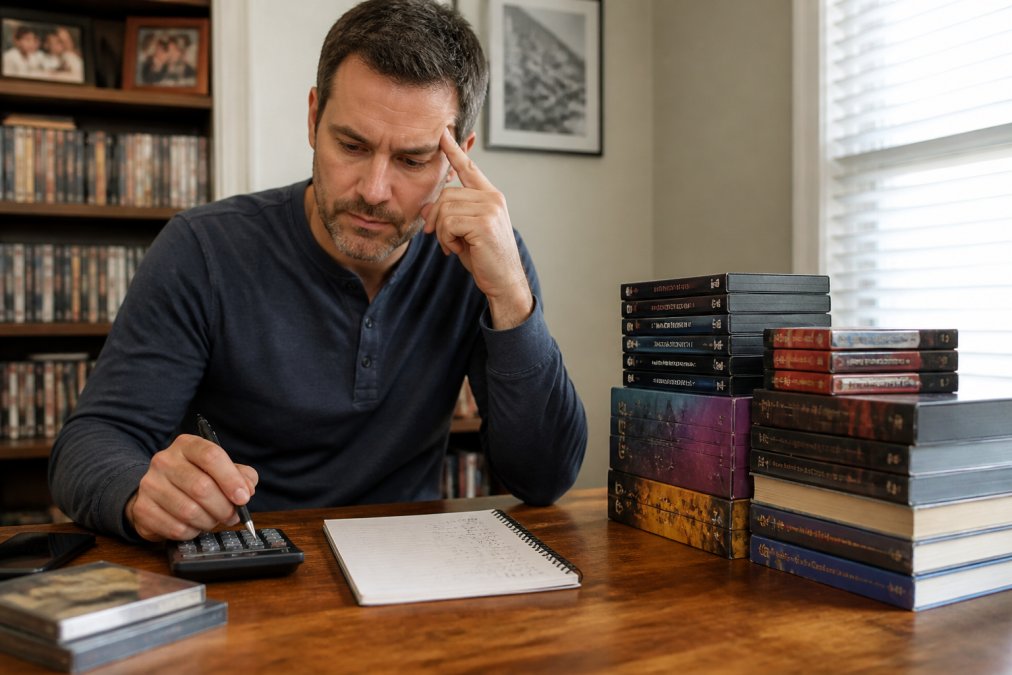
The real math isn’t just sticker price. It’s cost per unit, divided by how many volumes you’ll genuinely consume. Buy five books individually and abandon two, and your effective cost per finished book climbs fast. Buy the bundle and finish all five, and the per-unit cost drops.
A common mistake is comparing a bundle’s total price to a single discounted ebook on sale. That hides the fact that you need every volume to complete the story. Bundles win on total cost, not on the cheapest single item.
Bundle vs. Individual Discs: A Cost Comparison
Bundles almost always beat individual purchases on total cost per unit, but the gap depends on how many volumes you’d buy anyway.
| Factor | Complete Bundle | Individual Discs/Books |
|---|---|---|
| Cost per unit | Lower | Higher |
| Upfront spend | One payment | Spread over time |
| Missing volumes risk | None | Possible |
| Shelf space used | Consolidated | Scattered |
| Resale value | Higher as a set | Lower piecemeal |
| Commitment | Full series | Try one at a time |
Where bundles fall short is flexibility. If you only want the first book, a bundle forces you to pay for stories you may never open, which is why casual readers should think twice before committing to a full set.
How Bundle Pricing Is Actually Structured
Most complete-series bundles are not simply “all volumes added up, then discounted.” Publishers typically price them one of three ways:
- Sum-minus-discount. List prices are added, then a percentage is shaved off. A five-book set with $18 paperbacks ($90 total) at a 40% bundle discount lands near $54, about $10.80 per book (consumer.ftc.gov). Most common for fiction box sets.
- Flat bundle price. One number regardless of individual list prices, common for ebook sets where the marginal cost of a digital copy is near zero. A flat $9.99 ebook bundle covering five titles works out to roughly $2.00 per book.
- Tiered or volume-based. Price scales with title count, a three-book set at one price, a six-book set higher but sub-linear. Most common in audiobook bundles, where production cost per title is real.
The Per-Unit Math That Actually Matters
The number to compare is cost per volume you will finish, not sticker price. Run it like this:
- Add the list prices of every volume in the series.
- Subtract any individual-volume sales you’d realistically catch (most retailers discount backlist titles a few times a year).
- Compare that total to the bundle price.
- Divide the bundle price by the number of volumes you expect to finish, not the number in the box.
A worked example: a four-book series at $16 per paperback is $64 bought singly; catch two on a 30% sale and you’d pay roughly $54. A bundle at $42 is still cheaper, but only by about $12, and only if you finish all four. Finish three and your effective cost is $14 per finished book, worse than buying three individually on sale.
Where Bundles Genuinely Win
- Long series. The per-unit gap widens with volume count. A ten-book bundle almost always beats assembling ten singles, even with occasional sales.
- Out-of-print or low-stock volumes. A hard-to-find mid-series volume can cost more used than the entire bundle costs new.
- Matching editions. Buying singles over years risks a mid-series cover redesign, hard to fix later without rebuying.
Where Singles Genuinely Win
- Uncertain commitment. If you might stop after book one, the bundle is a bet you may lose.
- Deep single-title discounts. A $0.99 first volume or daily deal can beat the bundle’s per-unit average for that book.
- Library and subscription access. If a title is on a library app or subscription service, the effective cost of trying it is zero.
Before buying any bundle, price the same series three ways: the bundle, the sum of current single-volume prices, and the sum of used or library options. The bundle usually wins, but not always, and the exceptions are worth ten minutes of checking.
Best Complete Science Fiction Book Sets for Shelf Appeal
The best complete science fiction book sets pair strong storytelling with packaging that looks intentional on a shelf. Matching spines, consistent cover art, and uniform trim sizes turn a stack of paperbacks into a display piece, a real reason collectors prefer box sets over mismatched copies.
But shelf appeal is only half the story. The other half, which almost no buying guide covers, is technical quality variance. A bundle is not always the same product as the individual volumes it replaces.
Technical Quality Variance: What Changes Inside a Bundle
When a publisher assembles a complete-series bundle, they often re-master or re-author the underlying files rather than shrink-wrapping existing stock. That can go two directions:
- Higher bitrate, single-layer discs. Some bundles consolidate multiple discs onto fewer, higher-capacity ones. Done well, this preserves or improves quality; done cheaply, it compresses harder, yielding softer detail, banding in dark scenes, and thinner audio than the original releases.
- Reprinted paperbacks with thinner stock. Bundles are often printed as a single run rather than assembled from existing inventory, meaning lighter paper, tighter margins, and glued rather than sewn binding, readable, but less durable than a first-print single volume.
- Ebook bundles with fixed layout. Digital bundles sometimes ship as one file with locked formatting, which can break on smaller screens or older e-readers in ways the individual ebook would not.
The practical takeaway: a bundle is not automatically the same quality as the singles it replaces. Check whether the listing specifies “remastered,” “newly authored,” or “same discs as individual release,” and read reviews mentioning disc count, bitrate, or paper weight. If the listing is silent, assume the bundle was optimized for cost, not fidelity.
Shelf Appeal: What Actually Holds Up Over Time
Packaging design isn’t vanity. A well-made slipcase protects corners and spines, preserving resale value; cheap packaging does the opposite. Three things separate a set that still looks good in ten years from one that doesn’t:
- Slipcase rigidity. A rigid, printed full-wrap slipcase protects against shelf wear; a thin cardboard sleeve with a glued seam splits within a few years of normal handling.
- Spine consistency. Matching spine height, font, and color makes a set read as a set; one volume with a different trim size breaks the line visually.
- Cover art continuity. Series that change cover design mid-run, common after a film or TV adaptation, look broken on a shelf. Bundles usually lock in one art direction, a quiet advantage.
Format Obsolescence: The Shelf-Appeal Risk Nobody Mentions
A bundle’s shelf appeal is tied to a format, and formats age. DVD sets that looked great in 2008 are now hard to play without legacy hardware, and Blu-ray is following the same curve as 4K becomes standard (loc.gov). Book bundles don’t face this, paper has no format war, but disc bundles do, and the risk is real enough to factor into the purchase.
If you’re buying a disc bundle mainly for display, ask whether the format is still manufactured and whether a player will be available in ten years. If uncertain, the shelf appeal may not outlast the shelf.
Shelf appeal and technical quality are separate questions. A bundle can look beautiful and still ship with compressed discs or thinner paper than the singles. Check both before you buy, the listing usually tells you, if you know what to look for.
Pros and Cons of Book Box Sets
The pros and cons of book box sets come down to commitment versus convenience: box sets reward readers who know they’ll finish a series and punish impulse buyers who lose interest.
Pros:
Get the Ebook set at a 67% discount →
- Lower cost per unit than buying separately
- No missing volumes or gaps in the set
- Unified packaging that displays well
- Higher resale value as a complete collection
- One-time purchase, no repeated decisions
Cons:
- Full upfront commitment to the whole series
- Less flexibility if you dislike an early volume
- Bulkier to store and move than single books
- Discounted single ebooks can occasionally beat bundle pricing on one title
Buying a box set before reading book one is the most common regret. If you’re unsure about the tone or pacing, sample the first volume first. Committing to five books you might abandon wastes both money and shelf space.
How to Save Money on Book Series
How to save money on book series starts with timing and format, not luck. The biggest savings come from buying complete sets rather than assembling them volume by volume.
- Buy the bundle, not the pieces. Complete sets cost less per unit than individual volumes.
- Choose your format deliberately. Ebook bundles cost less than paperbacks and take zero shelf space.
- Skip the collector’s edition unless you’ll display it. Standard editions read the same.
- Watch for bundle discounts on full series. Jeffrey Poston Books delivers significant cost savings on complete series with discounted ebook, audiobook, and paperback sets.
- Resist the $0.99 single-book trap. One cheap first volume often leads to full-price sequels.
The $0.99 first-book deal is designed to hook you into paying full price for the rest. Run the total: bundle price versus first book plus every sequel at list. The bundle usually wins by a wide margin.
Risks of Bundles: Disc Rot, Missing Volumes, and Format Wars
Physical bundles carry risks digital libraries don’t. Disc rot, missing volumes, and format wars catch collectors off guard.
Disc rot is the slow deterioration of a disc’s reflective layer, which can make a title unplayable years after purchase (loc.gov). It affects some pressings more than others and is nearly impossible to reverse.
Missing volumes are a bundle-specific headache. A “complete” set that ships without one book or disc defeats the purpose, and replacements can be hard to source if a title is out-of-print.
Format wars create obsolescence risk. When a new format wins, older physical media gets harder to play without legacy hardware. Digital libraries sidestep this but carry their own risk: a platform can remove a title you “own.”
Physical bundles preserve your access as long as you maintain working hardware. Digital libraries trade that durability for convenience and platform dependence. Neither is risk-free.
The Environmental Impact of Physical Media Bundles
Physical media has a real environmental footprint, and bundles cut it. Manufacturing paper, ink, plastic cases, and discs consumes resources; shipping adds emissions. A single box set uses less packaging and fewer shipments than five separate orders, which lowers the total impact per title.
That said, physical media isn’t automatically greener. Digital delivery avoids manufacturing but shifts energy use to data centers and devices. Both have costs; bundles reduce the physical side by consolidating materials and transport.
For collectors who want physical media, buying complete sets is the lower-impact path: fewer boxes, fewer trips, less waste.
Decision Matrix: When to Buy the Bundle vs. Go Digital
The right choice depends on how you read, not which format is “better.”
| Your Situation | Best Choice | Why |
|---|---|---|
| You’ll finish the whole series | Buy the bundle | Lowest cost per unit |
| You want to display a collection | Physical bundle | Shelf appeal, resale value |
| You read on the go | Digital bundle | Portable, no shelf space |
| You’re unsure about the series | Single first volume | Test before committing |
| You commute and listen | Audiobook bundle | Convenience, hands-free |
| You move frequently | Digital bundle | No packing, no damage risk |
If you want an immersive, multi-book saga and know you’ll see it through, a complete bundle is the smart buy. If you’re testing the waters, start with one volume and upgrade later.
The challenge with any series purchase is committing before you know whether the story lands. Jeffrey Poston Books solves that with discounted complete sets across science fiction sagas, political thrillers, and historical westerns, in ebook, audiobook, and paperback. Readers get immersive, multi-book storytelling from a #1 bestselling author without paying full price volume by volume. Get the Ebook set at a 67% discount.
Frequently Asked Questions
Are complete series book bundles actually cheaper than buying individually?
Yes, complete series bundles typically offer a lower cost per unit than buying each disc or book separately. The discount comes from packaging and distribution savings that publishers pass on. For example, a bundle might list at a retail price that is 30 to 50 percent lower than the sum of individual volumes. However, the exact savings depend on the set and current discounts, so check the retailer’s listed price against individual listings before buying.
What are the main disadvantages of purchasing a box set?
The biggest downsides include limited flexibility (you commit to the whole set even if one volume disappoints), higher upfront cost compared to buying one book at a time, and the risk of damaged discs or missing volumes during shipping. Box sets also take up more shelf space than digital libraries. Some collectors report disc rot in older sets, and out-of-print bundles can be hard to replace if a single item is lost.
How do you determine if a book series is worth the investment of a bundle?
Start by reading sample chapters or reviews for the first book. Check whether the series has a consistent arc and a satisfying ending across all volumes. Look for bundle-exclusive bonus features like author notes or concept art. Compare the bundle’s cost per unit against buying used individual copies. If you enjoy the genre and the author’s style, a bundle reduces the risk of paying full price for later books you might not otherwise try.
What should you look for when buying a pre-owned complete series bundle?
Inspect the listing for clear photos of the spines, slipcase, and any discs. Ask the seller about scratches, missing inserts, or library markings. Verify the edition and region compatibility for discs. For books, check for water damage or loose bindings. Request a return policy. Pre-owned bundles can save money, but condition varies widely, so buy from sellers with detailed descriptions and positive feedback.